.png)
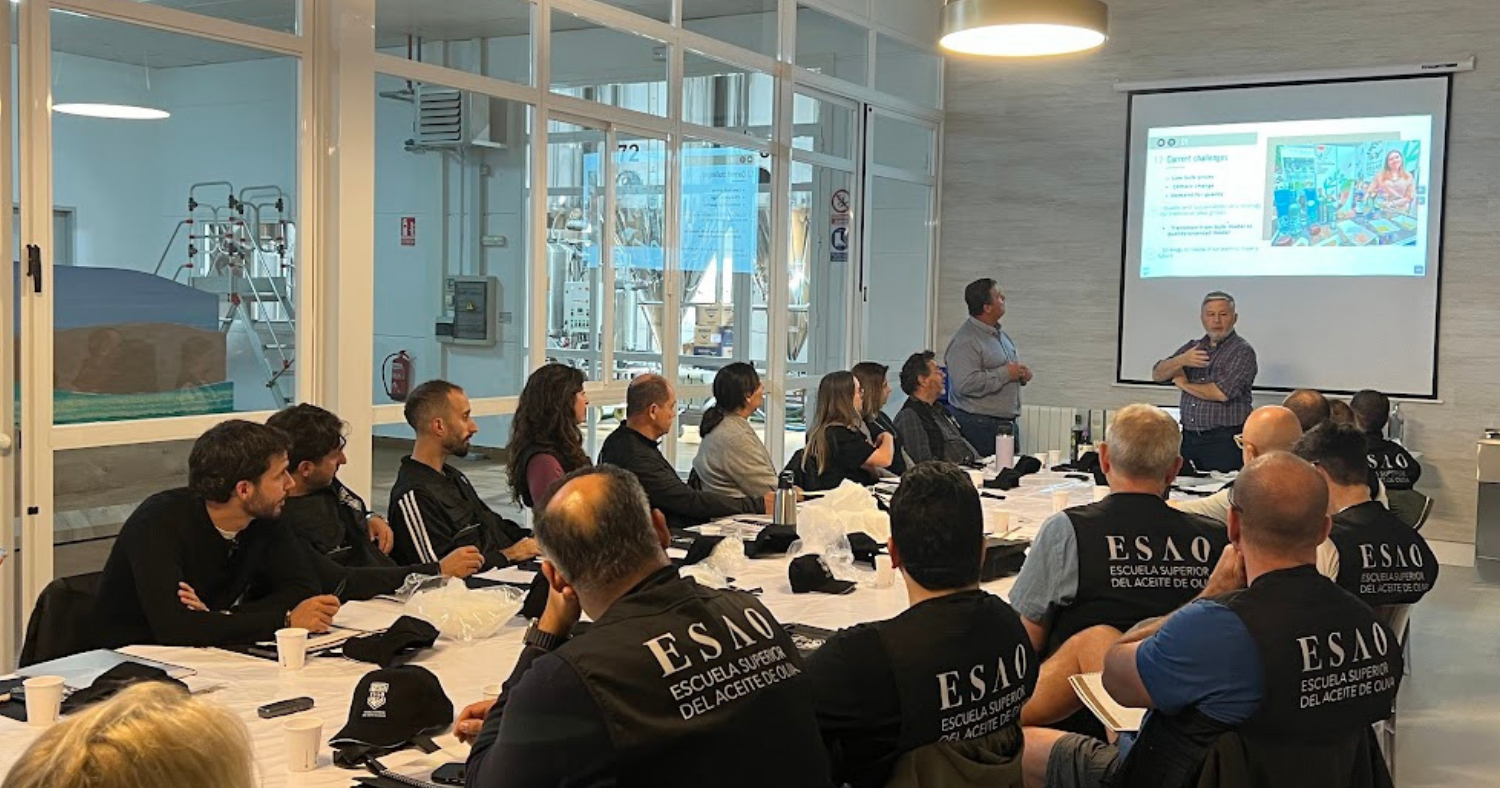
Source: ESAO Master Miller in-person training
The olive oil sector is evolving rapidly. New extraction technologies, regulatory changes, and consumer trends force professionals to constantly update their knowledge. To guarantee excellence, ongoing training in olive mills is no longer an option, but a strategic necessity.
In addition, if you want to deepen your understanding of how to measure and optimize extra virgin olive oil quality, you can consult this guide on EVOO quality KPIs, where key indicators are analyzed to improve processes, traceability, and performance in olive mills.
A master miller who continuously trains ensures high-quality extra virgin olive oil (EVOO), strengthens the competitiveness of the olive mill, and responds better to the demands of the global market, avoiding quality issues in EVOO production.
1. The importance of ongoing training in olive mills
The master miller is the guardian of quality. Their role goes far beyond operating machinery: they must understand every detail of the process, anticipate problems, and lead a team toward excellence, including the detection of common EVOO defects.
Without continuous technical development, even an experienced technician can fall behind competitors who incorporate innovations or master new quality standards and quality control in olive mills.
2. Key areas for technical development
Ongoing training in olive mills must cover both practical and strategic aspects.
-
Extraction processes: innovations in malaxation, centrifugation, and phase separation in EVOO extraction.
-
Quality control: new physical-chemical and sensory analysis methodologies applied to quality control in EVOO production.
-
Food safety and hygiene: updated protocols to comply with international certifications and ensure hygiene in olive mills.
-
Storage and preservation: inertization techniques, oxygen control, and tank management in EVOO storage.
-
Business management: team leadership, energy efficiency, and digitalization focused on process optimization in olive mills.
A well-trained master miller can integrate technique and management to achieve superior results and meet EVOO quality objectives.
3. Training as a competitive advantage
Investing in the training of the master miller directly impacts profitability:
-
Reduces losses caused by process errors.
-
Improves oil stability and shelf life.
-
Facilitates access to demanding international markets.
-
Builds trust among distributors and consumers through strong quality control in olive mills.
Updated knowledge is one of the most valuable assets of an olive mill, especially when supported by EVOO quality KPIs.
4. Available training formats
Today, different formats allow ongoing training in olive mills to adapt to the work rhythm of each technician or master miller:
-
In-person courses.
-
Online programs.
The key is to combine theory and practice so knowledge can be immediately applied.
5. Technological innovation and digitalization
Digitalization is transforming work in olive mills. An updated master miller must understand:
-
Real-time monitoring systems.
-
Digital traceability software.
-
Advanced sensors for tanks and extraction processes.
-
Data analysis tools to improve efficiency and the digitalization of KPIs in olive mills.
Technological training not only improves quality, but also optimizes costs and processes while facilitating EVOO quality audits.
6. International perspective on training
Each market has different requirements that force master millers to stay informed:
-
In the U.S., FDA compliance and food safety certifications are essential.
-
In Asia, consumers value freshness and innovative packaging.
-
In Northern Europe, sustainability and digital traceability are priorities.
A master miller who understands these demands adapts production to meet the standards of each destination, incorporating EVOO quality feedback systems.
7. The role of tasting in ongoing training
Technical tasting is a skill that requires constant practice. Recognizing common EVOO defects, identifying positive attributes, and anticipating deviations are abilities refined over time.
Training in sensory analysis should be a permanent pillar in the professional life of a master miller.
8. Building a learning culture in the olive mill
The training of the master miller should not remain individual. Their knowledge must be shared with the team to create a culture of quality. Therefore, ongoing training in olive mills should be part of the internal improvement strategy.
Strategies:
- Share learnings in internal meetings.
-
Train support staff in basic hygiene and control practices, reinforcing hygiene in olive mills.
-
Establish protocols based on updated knowledge and quality control in EVOO production.
An olive mill that learns collectively achieves consistency and sustainable growth.
9. Challenges in maintaining ongoing training
There are common obstacles:
-
Limited time during harvest season.
-
Lack of financial resources for training.
-
Resistance to change in teams used to traditional methods.
Overcoming these challenges means viewing training not as a cost, but as a strategic investment in quality, supported by EVOO quality audits and process improvement.
Ongoing training in olive mills is key to maintaining excellence in an increasingly competitive and globalized sector. Developing technical knowledge, mastering innovations, and understanding international markets ensures that every EVOO batch meets expectations and fulfills EVOO quality objectives.
Important note
This article is only an introduction. Real technical training requires specialized programs and a comprehensive approach.
In the ESAO Executive MBA – Olive Oil Consultant, you will find a training program designed for master millers and technicians, with a global vision of the olive oil sector.