.png)
Source: ESAO Image Bank
In fine dining, every detail matters
Extra virgin olive oil (EVOO) is no longer a simple accompaniment: it is a product with its own identity, capable of adding nuance and differentiation. To integrate it properly into a menu, it is essential to understand it in depth. Premium EVOO tasting allows professionals to discover its qualities, describe them precisely, and convey them to the guest as part of the gastronomic experience.
If you would like to explore further the EVOO trends in fine dining, how to create EVOO pairings, and how to choose the best EVOO on the restaurant menu, visit our complete guide to EVOO in gastronomy, where we explore all these aspects in detail.
Mastering EVOO in fine dining means knowing how to taste a premium extra virgin olive oil with professional criteria and communicate its value in every service.
This article offers a practical introduction to tasting and description techniques, designed for chefs and sommeliers who want to master the sensory language of olive oil.
1. Why taste a premium EVOO?
Taste a premium extra virgin olive oil is not only a technical matter; it is a gastronomic communication tool. Sensory tasting allows you to:
-
Identify top-quality olive oils.
-
Differentiate EVOO varieties and styles.
-
Select the right EVOO for each dish and pairing.
-
Communicate with guests using attractive and professional language.
In fine dining, mastering EVOO tasting is as important as knowing wines or cheeses. It is also fundamental to communicate the value of EVOO from the kitchen or dining room.
2. The tasting environment
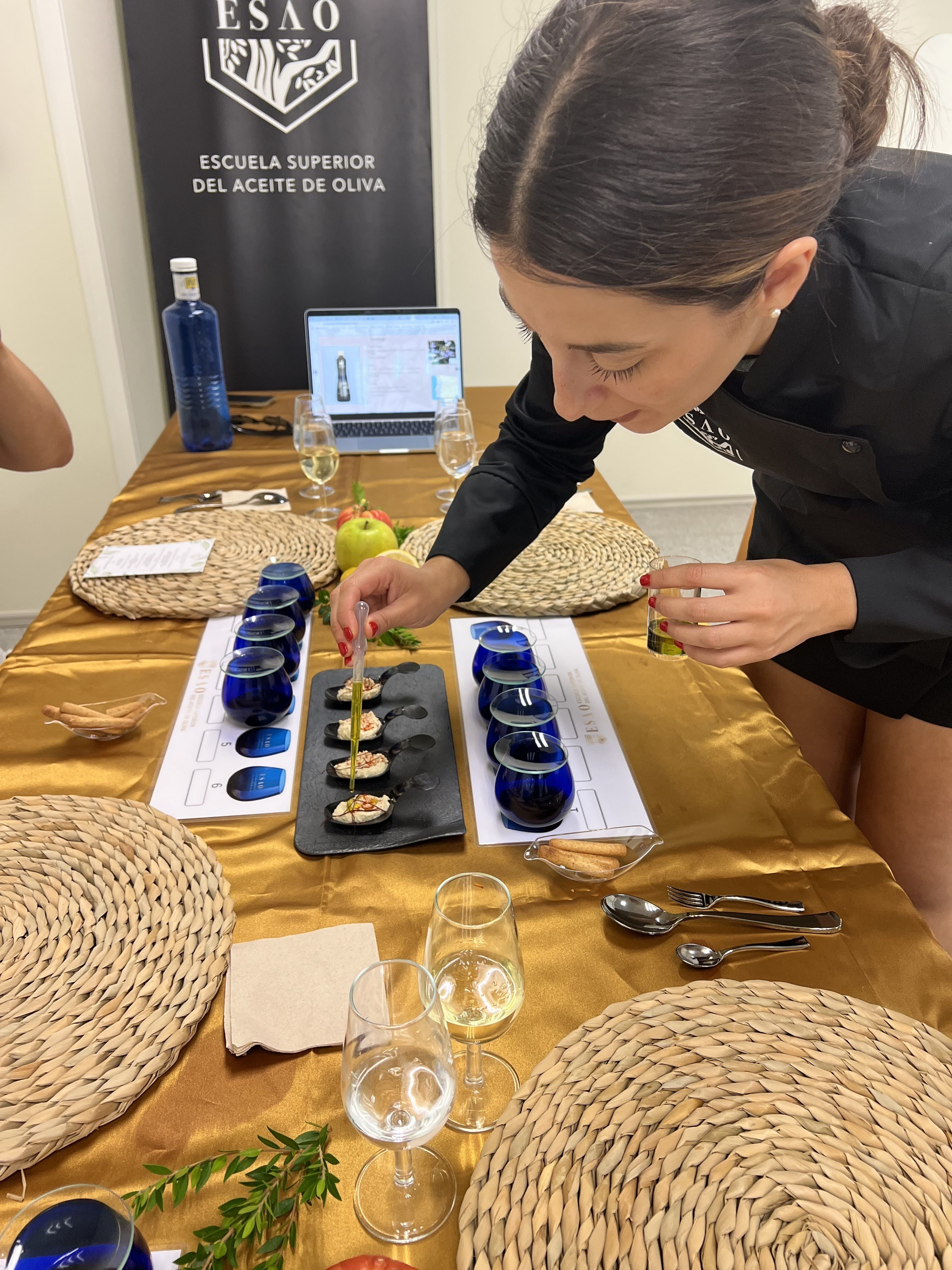
To obtain reliable results, tasting must be carried out under controlled conditions:
-
Opaque glass (blue or amber) to avoid visual bias.
-
Temperature between 26–28 ºC, which enhances the release of aromas.
-
Neutral environment, free from external odors that may interfere.
-
Calm and concentration, essential to perceive nuances.
A professional setting makes the difference between a superficial impression and a precise evaluation, especially when applying knowledge in EVOO tastings for restaurants or trade fairs.
3. Phases of premium EVOO tasting
Sensory tasting is divided into three main phases:
a) Olfactory phase
The glass is covered with the hand, slightly warmed, and deeply inhaled. Attributes evaluated include:
-
Green fruitiness (leaf, grass, tomato).
-
Ripe fruitiness (apple, almond, banana).
-
Aromatic intensity and complexity.
b) Gustatory phase
A small sip is taken, spread throughout the mouth, and air is aspirated to oxygenate. The following are analyzed:
-
Bitterness: sensation on the tongue.
-
Pungency: sensation in the throat.
-
Balance between positive sensations.
c) Retronasal phase
Aromas perceived while exhaling complete the sensory experience and confirm the oil’s persistence. This analysis is key in EVOO staff training for both kitchen and dining room teams.
4. How to describe a premium EVOO
The description should be clear, attractive, and professional. Instead of saying “strong oil” or “mild oil,” sensory terms are used to connect with the guest:
-
“Notes of freshly cut grass with an elegant and persistent pungency.”
-
“Nutty aroma with balanced bitterness that cleanses the palate.”
An evocative language turns the explanation into part of the gastronomic experience and is essential to position the EVOO on the restaurant menu.
Source: ESAO Image Bank
5. Comparative tasting: the best learning tool
An effective technique for chefs and sommeliers is comparative tasting of different EVOO varieties and origins. Examples:
-
Arbequina vs. Picual: delicacy versus intensity.
-
Hojiblanca vs. Koroneiki: Mediterranean balance versus Greek freshness.
-
Early harvest vs. mature harvest: aromatic power versus sweetness.
Comparison helps to understand nuances, the impact of terroir in EVOO, and to choose wisely for the menu, including the best EVOO pairings.
6. The role of the sommelier in the dining room
The sommelier does not only select wines; they can also guide guests through the EVOO experience:
-
Offer a mini tasting at the beginning of the menu.
-
Explain differences between the oils served.
-
Recommend a specific EVOO for each dish, just as with wine.
This reinforces professionalism and positions the restaurant as an innovative reference in the use of EVOO in healthy cuisine, including proposals such as EVOO in desserts or the concept of local EVOO.
Source: ESAO Image Bank
7. International perspective
EVOO tasting is gaining prominence worldwide:
-
In the U.S., consumers look for premium oils with certifications and detailed tasting notes.
-
In Asia, olive oil tasting is associated with luxury products.
-
In Northern Europe, EVOO staff training is key to justifying premium prices.
Understanding tasting also helps professionals recognize the impact of process optimization in the olive oil mill on sensory results and consistency, as well as the importance of KPIs for success in olive oil mills behind every high-quality oil.
It is also useful to identify common defects in EVOO that can undermine the experience, such as rancidity or musty notes, even before the oil reaches the dining room.
Mastering tasting is also a competitive advantage for chefs and sommeliers operating internationally and following EVOO trends in fine dining.
8. Common mistakes when tasting and describing EVOO
-
Relying only on visual appearance (color is not an indicator of quality).
-
Using imprecise or overly technical language with guests.
-
Not renewing oils: oxidized EVOO ruins the experience.
-
Serving oil without prior staff training.
Avoiding these mistakes is essential to maintain an effective EVOO menu marketing strategy that truly communicates value.
Conclusion
Premium EVOO tasting is an essential skill for chefs and sommeliers seeking differentiation in fine dining. Through it, they not only select high-quality EVOOs, but also enrich the gastronomic experience, create surprising EVOO pairings, and communicate the value of a unique product to the guest.
Important note
This article is an introduction. To truly master premium EVOO tasting and description, specialized EVOO training, guided practice, and expert mentoring are required.
In the MBA Executive ESAO – Olive Oil Consultant you will learn professional EVOO tasting and description techniques through practical sessions and real cases applied to high-level gastronomy.